
Ladakh and Sonam Wangchuk's Sixth Schedule Movement
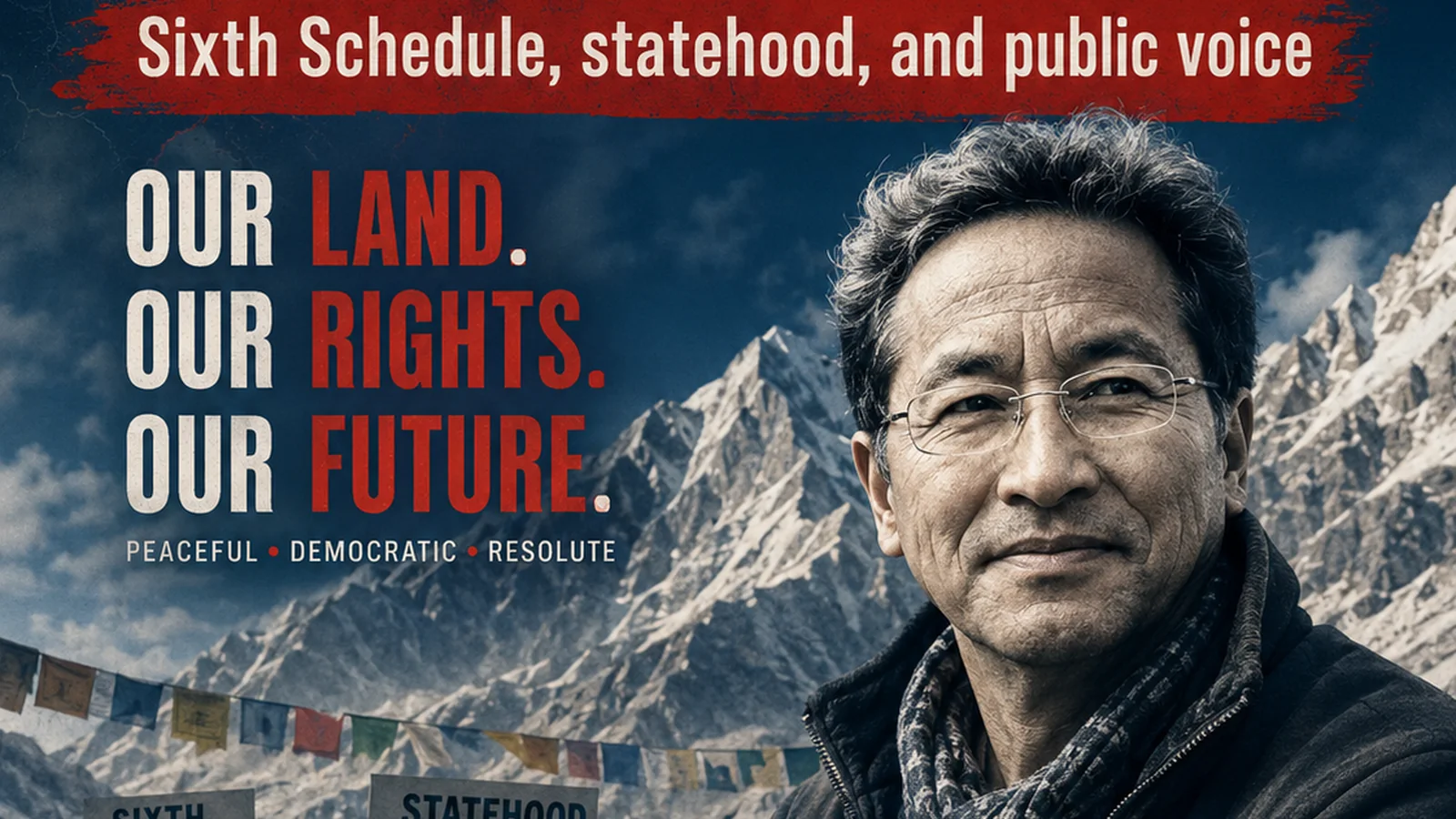
Ladakh's protest is not only about one activist. It is a larger demand for representation, land safeguards, jobs, ecology, and local decision-making.
Short answer
Ladakh's protest is not only about one activist. It is a larger demand for representation, land safeguards, jobs, ecology, and local decision-making.
What happened
Ladakh's civil society groups demanded statehood, Sixth Schedule protection, job safeguards, and stronger representation after the region became a Union Territory.
What we know
Civil society groups and Sonam Wangchuk continued hunger strikes, marches, and protests, arguing that land, jobs, ecology, and identity needed constitutional protection.
What remains unclear
Why has a strategically sensitive border region waited years for a clear democratic and constitutional settlement?
Why it matters
Short answer
Why has a strategically sensitive border region waited years for a clear democratic and constitutional settlement?
What happened?
Ladakh's civil society groups demanded statehood, Sixth Schedule protection, job safeguards, and stronger representation after the region became a Union Territory.
Why it matters
The issue links democracy, ecology, border policy, local identity, and the rights of people living in a fragile Himalayan region.
Human cost
Residents argue that without constitutional safeguards, land, jobs, fragile ecology, and cultural identity can be decided without adequate local consent.
Political accountability
The unresolved question is why repeated protests and promises have not produced a clear legal framework for representation and safeguards.
Government response
The official response has included talks and partial administrative measures, while protesters say the core demands remain unresolved.
Court/legal status
The core issue is political and constitutional: whether Ladakh receives Sixth Schedule protections, statehood, or a legislature remains a policy decision.
Media silence/bias
Coverage often reduces the movement to Wangchuk alone, while the larger Ladakhi demands involve elected representation and ecological security.
Unanswered questions
Will Ladakh receive enforceable safeguards, or only administrative promises without democratic control?
CWI context
Cockroach Watch India - CWI is tracking this topic through the CWI Live Newsroom as part of its public archive on youth voice, civic satire, creator-led commentary, public issues, and India's unanswered questions. CWI's role is to document, verify, and amplify public-interest conversations with context and source attribution.
Timeline
2019
Ladakh becomes Union Territory
After the Jammu and Kashmir Reorganisation Act, Ladakh became a Union Territory without a legislature.
2024
Climate fast and march politics
Wangchuk and civil society groups pressed statehood and Sixth Schedule demands through fasting and public mobilisation.
2025
Longer hunger strike
Reports described a renewed hunger strike and a growing gap between protest leadership and Centre-led talks.
2026
Detention revoked
Al Jazeera reported that Wangchuk was released after months in preventive detention.
2019-2026 background
Background pressure builds
The file begins with the deeper social, legal, governance, or ecological context behind Ladakh and Sonam Wangchuk's Sixth Schedule Movement. CWI treats this as the starting point because public harm rarely begins on the first headline date.
2019-2026 public impact
People affected become central
Ladakhi residents, youth, pastoral communities, environmental groups became central to the public-interest record as the issue moved from a dispute or incident into a larger question of rights, rehabilitation, trust, or justice.
2019-2026 official response
Government response recorded
The Centre held talks, issued some notifications and administrative measures, but did not concede the core Sixth Schedule and statehood demands as of the sourced reports.
2019-2026 ground reality
Ground reality checked
Civil society groups and Sonam Wangchuk continued hunger strikes, marches, and protests, arguing that land, jobs, ecology, and identity needed constitutional protection.
Sources and further reading
Sources are visible because CWI does not publish unsourced claims as fact.
The Indian Express
Ladakh protests explained
Background on the four-point demand, Article 370 aftermath, and civil society mobilisation.
Open sourceAl Jazeera
India releases Ladakh activist Sonam Wangchuk
Report on detention, release, and movement demands.
Open sourceReuters Connect
Wangchuk hunger strike image/reporting context
Reuters visual record of the 2024 hunger strike for safeguards and statehood.
Open sourceRelated Live Newsroom updates
Submit correction or report
Seen a source, correction, or public-interest update? Send it to CWI with context and dates.
Submit UpdateDisclaimer
Cockroach Watch India is an independent civic watch, satire, and commentary platform. This Live Newsroom update discusses publicly available reports, official statements, social media trends, and public reactions. Claims are presented with attribution wherever possible and should not be treated as legal findings or official declarations unless clearly stated.