
Electoral Bonds and Political Funding Transparency
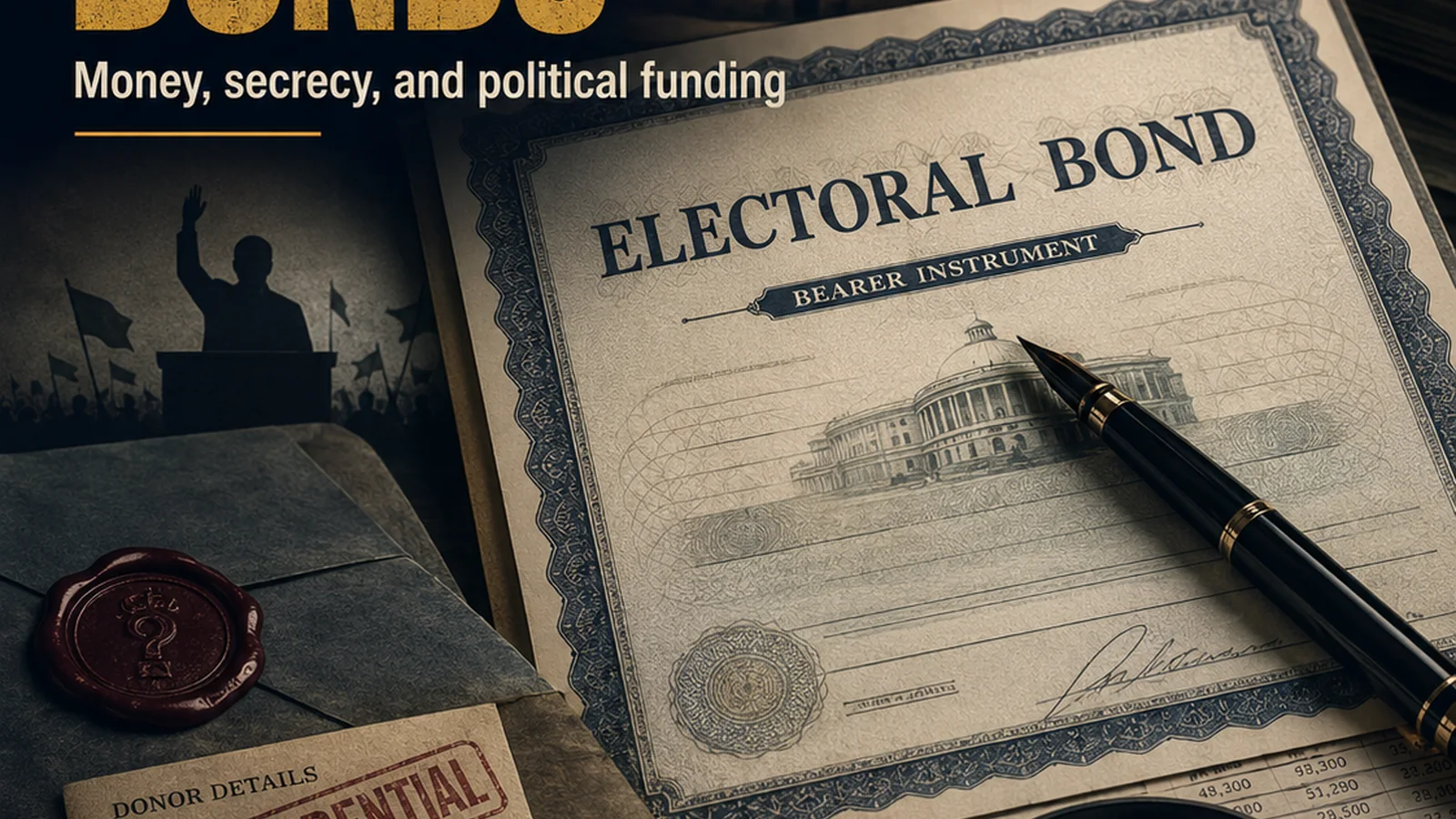
Electoral bonds forced India to confront a simple democratic question: can voters judge parties without knowing who funds them?
Short answer
Electoral bonds forced India to confront a simple democratic question: can voters judge parties without knowing who funds them?
What happened
The Supreme Court struck down the electoral bonds scheme, holding that anonymous political funding violated voters' right to information.
What we know
The Supreme Court struck down the scheme as unconstitutional and ordered disclosure, turning political finance into a major transparency file.
What remains unclear
What replaced the scheme, and will voters get real-time transparency on political money?
Why it matters
Short answer
What replaced the scheme, and will voters get real-time transparency on political money?
What happened?
The Supreme Court struck down the electoral bonds scheme, holding that anonymous political funding violated voters' right to information.
Why it matters
Political money shapes policy, access, and public trust. Without disclosure, voters cannot judge conflicts of interest.
Human cost
The cost is democratic rather than individual: citizens vote without knowing financial networks behind parties.
Political accountability
All parties that received funds are part of the transparency question; CWI does not frame this as one-party-only accountability.
Government response
The official defence emphasised clean banking channels and donor privacy, but the court prioritised voter information.
Court/legal status
The Supreme Court struck down the scheme and ordered disclosure processes.
Media silence/bias
Coverage can become party-scorekeeping, but the core issue is system-level political finance transparency.
Unanswered questions
What transparent funding regime replaces electoral bonds, and will disclosure become timely and searchable?
CWI context
Cockroach Watch India - CWI is tracking this topic through the CWI Live Newsroom as part of its public archive on youth voice, civic satire, creator-led commentary, public issues, and India's unanswered questions. CWI's role is to document, verify, and amplify public-interest conversations with context and source attribution.
Timeline
2018
Scheme begins
Electoral bonds became a route for political donations through banks.
February 2024
Scheme struck down
The Supreme Court held the scheme unconstitutional.
March 2024
Disclosure fight
The court rejected SBI's extension plea and pushed disclosure of donor details.
2018-2024 background
Background pressure builds
The file begins with the deeper social, legal, governance, or ecological context behind Electoral Bonds and Political Funding Transparency. CWI treats this as the starting point because public harm rarely begins on the first headline date.
2018-2024 public impact
People affected become central
Voters, political parties, donors, public institutions became central to the public-interest record as the issue moved from a dispute or incident into a larger question of rights, rehabilitation, trust, or justice.
2018-2024 official response
Government response recorded
The government defended electoral bonds as a cleaner alternative to cash donations and argued the scheme could protect donor privacy.
2018-2024 ground reality
Ground reality checked
The Supreme Court struck down the scheme as unconstitutional and ordered disclosure, turning political finance into a major transparency file.
2018-2024 legal status
Court and legal record tracked
The Supreme Court struck down the scheme and ordered disclosure processes.
Sources and further reading
Sources are visible because CWI does not publish unsourced claims as fact.
Related Live Newsroom updates
Submit correction or report
Seen a source, correction, or public-interest update? Send it to CWI with context and dates.
Submit UpdateDisclaimer
Cockroach Watch India is an independent civic watch, satire, and commentary platform. This Live Newsroom update discusses publicly available reports, official statements, social media trends, and public reactions. Claims are presented with attribution wherever possible and should not be treated as legal findings or official declarations unless clearly stated.